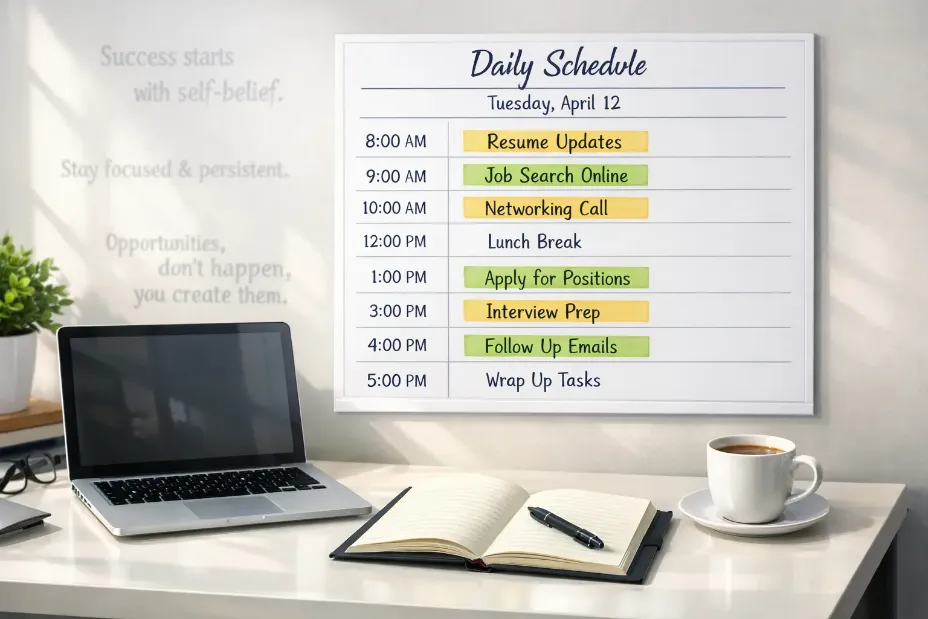
Apply to enough jobs and something will stick — that is the usual advice, and it rarely works. Hiring data from CareerPlug's 2025 Recruiting Metrics Report - an analysis of more than 60,000 employers and 10 million applications - puts the average applicant-to-interview ratio at 3% and the number of applicants per hire at 180. Working to a plan that targets the right roles, instead of sending the same resume everywhere, is what moves you out of that pile.
That is the difference quality makes: a targeted application is judged on its own merits, while a generic one competes with every other generic submission.
A job search without a strategy is like sailing without a compass: it moves, but seldom in the right direction.
This is where a perfect daily job search action plan makes the difference. Working from a defined strategy keeps a search focused, and makes it far easier to stay consistent when replies are slow.
In this guide, you’ll learn how to improve your job application-to-interview conversion rate without burning your energy on applications that go nowhere. You’ll understand how to structure your day, where to focus your energy, and how to stay consistent, even if it feels bad. Instead of feeling stuck or discouraged, you’ll have a clear plan that creates daily momentum and brings you closer to landing your next role.
Quick answer: a job search action plan is a written daily schedule for your search — which roles you target, how many tailored applications you send, and when you follow up on each one. FuqHR’s free tracker turns that plan into a Google Sheet you can measure: one row per application, a follow-up date and a running application-to-interview rate.
Make a copy of the free FuqHR job search tracker and start with a single row today.
Job Search Action Plan Template
Here is the template itself, before the reasoning: five rows, one per working day, that turn “I should apply more” into a plan you can tick off. Copy the grid into a spreadsheet, a notes app or a paper notebook — the wording matters less than filling every cell before Monday.
| Day | Focus for the day | Applications | Follow-ups due | Learning block |
|---|---|---|---|---|
| Monday | Refresh the target list: the companies and roles worth a tailored application this week. | 2–3 tailored | Everything sent last week | One skill the ads keep naming — 30 min |
| Tuesday | Take the strongest role on the list and rewrite one CV and one cover letter for it. | 2–3 tailored | One polite nudge on the oldest application | Same skill, one practice task |
| Wednesday | Networking day: two warm messages to people who do the job you want, one reply chased. | 1–2 tailored | Answer every thread that moved | Read two job ads for patterns |
| Thursday | Interview prep for anything live; if nothing is live, apply to the next tier of roles. | 2–3 tailored | The applications from Monday and Tuesday | Practise one answer out loud |
| Friday | Review the week: which roles replied, which ones were a waste of a tailored CV. | 1–2 tailored | Close the loop on anything older than a week | Plan next week’s target list |
Three rules keep the grid honest, and they are the difference between a plan and a wish list:
- Decide Friday’s review before Monday. Write down what a good week would look like — replies, interviews, a shortlist — so the daily rows have something to aim at.
- One row per day, not one list per week. A week-long to-do list gets pushed to Thursday and then abandoned; a single row is small enough to finish.
- Follow-ups are their own column. The application you sent is only half the work — the nudge is the half most people skip.
How to use the template
- Copy the five rows into whatever you already open every day. A spreadsheet is easiest to count from; paper works if you actually look at it.
- Before the week starts, write Monday’s target list: named companies and named roles, not “marketing jobs”.
- Each morning, open today’s row and do the first item before email. The order inside the row is the plan. If the learning cell is still vague, replace it with the name of the skill and the exact resource — a course lesson, the docs, or a practice task you can finish in the block.
- At the end of the week, look at the replies column. If a month passes with no replies, treat that as a signal to change the targeting — the role, the level or the market — rather than to send more of the same.
If you would rather not build the grid yourself, make a copy of FuqHR’s free job search tracker: the same plan, with a follow-up date on every row and a running application-to-interview rate. The rows only pay off if the CV behind them matches the ad, so pair the plan with a CV tailored to each job description and check it against the ad with our ATS score guide before you send it.
The rest of this guide explains how to run each row — starting with why the daily rhythm matters at all.
Let’s begin by understanding why a daily action plan isn’t optional, but rather, essential.
Why You Need a Daily Job Search Action Plan
Most job seekers underestimate how much noise there is in the hiring process. If your resume is hard for that software to parse, or clearly unrelated to the posting, your application starts near the bottom of the pile. An ATS-friendly resume template is a reasonable starting point. A 2025 systematic review of 49 studies on AI in recruitment found that automated resume parsing and initial screening are now standard parts of the pipeline — which is why the material you submit has to be easy for software to read and clearly relevant to the role.
Without a daily action plan:
- You may apply to too many jobs too quickly, reducing the quality of each application.
- Your energy and motivation can drain rapidly, increasing stress and burnout.
- Follow-ups and networking opportunities fall through the cracks, often silently and without a feedback.
When you adopt a structured plan, you create consistency, build momentum, and ensure that every day moves you closer to your goal. This keeps you focused and makes your efforts measurable, which is critical for refining your strategy over time.
Now that you understand why structure matters, let’s talk about how much time you should dedicate to your job search and how that time varies based on your situation.
Properly allocating time spent for effective daily job application
In today’s competitive labor market, simply scrolling job boards and submitting dozens of applications isn’t enough. You have to focus on other things like improving your resume, ATS optimizing the resume, properly weeding out job postings, tracking progress and conversion rates from job applications to interviews, learning how to handle interviews and improving your skills.
A structured daily routine helps you focus less on quantity and more on the activities that actually boost your odds of landing interviews. A deliberate job search plan encourages thoughtful applications, targeted networking, and ongoing skills development, all of which create momentum and reduce stress.

The truth? Focusing on quality over quantity yields far better results and less misery!
As you progress through job applications, you'll notice the pattern the data above describes: focused, tailored applications pull ahead of volume, and the same hours spent on them go further. Keep that trade-off in mind when you plan your week. We'll discuss this further later on.
Next, let’s explore how much time each day you should realistically dedicate to this effort.
How Much Time Should You Dedicate to Your Job Search Each Day?
One of the most common questions job seekers ask is, “Am I doing enough?” The answer isn’t about how many applications you submit, but rather, it’s about how intentionally you use your time. The ideal daily time commitment depends heavily on your current employment status, as this LinkedIn article on daily job-search time points out. Unemployed job seekers benefit from treating the job search like a part-time job, while employed professionals need a more discreet, highly targeted approach.

The number of hours matters less than how they are spent: two focused hours of targeted work beat a whole day of scrolling, and consistency matters more than intensity.
Once you understand how much time to dedicate, the next step is knowing how to structure that time throughout the day. That’s where a detailed daily schedule makes all the difference.
The Complete Daily Action Plan (6:00-17:00): A Research-Backed Routine
To make real progress in your job search, you need more than intention, you need a daily structure that aligns high-impact activities with how your energy naturally flows. The correct way to stay consistent and not burn-out is to divide your dour day into "focused blocks" rather than reacting to alerts or scrolling job boards.
This helps maintain momentum, boosts productivity, and in the end, reduces burnout. Time-blocking is a proven strategy used by successful job seekers to treat the search like a productive workday rather than a chaotic chore.
The routine below breaks your typical day into achievable sections, guiding you through applications, networking, skill improvement, follow-ups, and personal wellbeing. It’s adaptable based on your situation-whether you’re unemployed full-time or balancing a job hunt with work or other commitments.
Morning Routine: Energize, Plan, and Apply (6:00–9:00)
Starting your day strong makes it easier to handle the most mentally demanding tasks first, like researching roles, tailoring resumes, and submitting thoughtful applications. Many people find that mornings are the best time for deep focus and meaningful progress.
- 6:00–6:30: Morning mindfulness, tea or coffee, and light stretching to wake up your body and clear your head.
- 6:30–7:00: Strategy review. Look over your goals for the day, set priorities, and decide what absolutely needs to get done.
- 7:00–8:00: Job board check and company research to shortlist roles before you start applying.
- 8:00–9:00: Tailor applications and submit targeted resumes and cover letters. Fewer high-quality applications are usually more effective than sending many generic ones.
Mid-Morning Routine: Networking & Follow-Up (9:00–12:00)
Networking is a key part of any job search. Platforms like LinkedIn make it easier to connect with professionals, recruiters, and hiring managers. These conversations often lead to opportunities that never get posted publicly.
- 9:00–10:00: Outreach. Send personalized messages and follow up with people you have already spoken to.
- 10:00–10:30: Email check. Respond quickly and professionally to recruiters or interview requests.
- 10:30–11:00: Quick skill boost. Watch a short tutorial, work through a lesson, or read an article related to your field.
- 11:00–12:00: Plan next week’s priority contacts and outline what to focus on for interview preparation.
Lunch & Recharge (12:00–13:00)
Taking a real break matters. Stepping away from your screen during lunch helps you reset and come back with more energy for the rest of the day.
Afternoon Routine: Learning & Strategy (13:00–16:00)
The afternoon is a good time for work that supports long-term progress, like building skills, digging deeper into companies, and staying up to date with industry trends. A strong job search is about consistency and learning, not just sending applications.
- 13:00–14:00: Skill building through online courses, certifications, or portfolio projects.
- 14:00–15:00: Industry reading. Catch up on articles, reports, or news related to your field.
- 15:00–16:00: Follow-ups and reflection. Reply to messages, review your application tracker, and note next steps.
Late Afternoon Wind-Down (16:00–17:00)
Wrapping up your day with a short review helps you see what you accomplished and sets you up for a smoother start tomorrow. Ending with clarity makes it easier to stay motivated over the long run.
- 16:00–16:30: Review your application tracker and update the status of each role.
- 16:30–17:00: Set clear goals for the next day so you know exactly where to begin.
This routine balances productivity with well-being, helping you stay focused without burning out. Time-blocking gives your day structure without feeling rigid, and spreading tasks across different areas ensures the most important parts of your job search get the attention they deserve.
Next, we’ll dive into the question that everyone has, and it's: How many job applications should I do?
How many applications should I do every day/week?
A review of 12 studies by The Interview Guys lands on a wide range: somewhere between 32 and 200 applications per offer, with most estimates pointing to 100 or more. One 2025 study cited there found the average job seeker sending 32 applications and landing 4 interviews before being hired. The spread is the point — how you apply changes the number, so each application has to work harder for you.
Limiting yourself to a small number of applications a day is what buys the time to customize each resume, mirror the job description’s language and show genuine fit — the three things the keyword-matching stage of an applicant tracking system (ATS) actually scores.

The reason this approach works is simple. Fewer applications allow you to:
- Spend adequate time tailoring your resume and cover letter to match each role.
- Research the company’s culture, challenges, and priorities.
- Incorporate relevant keywords that improve ATS performance.
- Maintain emotional energy and avoid application fatigue.
- Prepare adequately for job interviews.
By contrast, applying to 20 or more jobs per day almost guarantees generic materials and recruiters can spot them instantly. One widely cited eye-tracking study, reported by Recruiter.com, found that recruiters spend roughly six seconds on a first pass over a resume. That is the budget your top third of the page is competing for.
Next, we’ll break down the critical tactics that turn high-quality applications into interview invitations, starting with how to extract CV keywords from a job description and customize your resume effectively.
Critical Tactics to Maximize Your Job Search Success
Once you’ve committed to a quality-first application strategy, execution becomes everything. The most successful job seekers don’t just apply, they apply intelligently. That means breaking down job postings, tailoring every resume, tracking progress meticulously, and following up professionally. Each of these tactics is grounded in how hiring actually works.
1. Deconstruct Every Job Description Before You Apply
A job description isn’t just a list of requirements, it’s a roadmap. Recruiters and hiring managers write postings to describe their biggest problems and the skills needed to solve them. Treat each posting like a brief you have to respond to.
Before applying, identify:
- Non-negotiables: Degrees, certifications, work authorization, or licenses.
- Core skills: Repeated keywords and competencies that appear multiple times.
- Tone and language: Formal vs. conversational, technical vs. strategic.
- Implied pain points: What problem is this role meant to fix?
Mirroring this language in your resume and cover letter helps both ATS software and human reviewers quickly see alignment.
2. Customize Your Resume for Every Application
Generic resumes are the fastest way to get rejected - but not because a bot flips a switch. The widely repeated claim that an ATS rejects 75% of resumes before a recruiter sees them has no primary source behind it, and it does not match what recruiters report: in a survey of 25 recruiters at US employers by Enhancv, 92% said their system never auto-rejects a resume for formatting, content or design. The real culprit is volume - hundreds of applications for one opening, and reviewers who read only the most relevant ones first. See what an ATS can actually see for the mechanics. Customization still matters, because it decides where you land in that reading order - but it works through relevance, not by tricking a filter.
To increase your chances:
- Incorporate keywords directly from the job description.
- Use a clean, ATS-friendly format (no tables, graphics, or unusual fonts).
- Quantify achievements with numbers, percentages, or outcomes.
- Customize your summary and top 3-4 bullet points for each role.
Think of your resume as a tailored response, not a biography. Our step-by-step guide to tailoring your CV to a job description shows how to do it in order, without rewriting the whole document. If you are writing your first CV and there is no work history to tailor yet, our guide to a CV with no experience covers what counts as evidence.
Doing this by hand for every single role is where most people burn out. FuqHR takes your existing CV and the job ad you are targeting and returns a tailored, ATS-friendly version in minutes, with a live ATS score so you can see the difference before you apply.
Not sure why a tailored resume still gets ignored? Start with how ATS ranks your resume to see what the software reads before a human opens your file.
3. Build and Maintain a Strong Application Tracker
Organization is a competitive advantage. Without a tracker, follow-ups are missed, patterns go unnoticed, and opportunities slip away. Our free job application tracker for Google Sheets does that job: one row per application, the date you applied, the follow-up date and the reply, plus a running application-to-interview rate.

This system not only prevents missed follow-ups-it helps you evaluate what’s working and refine your approach.
Want the file itself rather than the guide? Make a copy of the FuqHR tracker, delete the sample rows, and add your first application today.
4. Network Strategically (Not Randomly)

Referred and networked applicants convert to interviews far more often than mass cold applications.
Cold applications will always be part of a job search, but networking is where leverage lives. Referred candidates are consistently more likely to be interviewed and hired than cold applicants.
Effective networking includes:
- Connecting with professionals at target companies.
- Requesting informational interviews or “coffee chats.”
- Engaging meaningfully with industry content on LinkedIn.
- Reconnecting with former colleagues and managers.
The goal isn’t to ask for a job, it’s to build visibility, trust, and context.
5. Follow Up Professionally and Consistently
Many job seekers never follow up, which silently removes them from consideration. Recruiters often interpret silence as lack of interest. Indeed’s career guide suggests waiting seven to 14 days after applying — or one to two days after a posted deadline passes — before following up.
A strong follow-up:
- References the specific role and date applied.
- Reaffirms genuine interest.
- Briefly highlights 1-2 relevant strengths.
- Stays under 4 sentences.
Subject: Follow-Up on Application for [Job Title]
Hi [Hiring Manager’s Name],
I wanted to follow up on my application for the [Job Title] role, which I submitted on [date]. I’m very interested in the opportunity and believe my experience with [relevant skill or achievement] aligns well with what your team is looking for. I’d welcome the chance to discuss how I could contribute to [Company Name].
Thank you for your time and consideration,
[Your Name]
This small step keeps you visible and signals professionalism-two traits hiring managers value highly. With these tactics in place, your daily efforts become sharper and more effective.
Next, we’ll zoom out and look at how to structure your job search across weeks, not just days, to maintain momentum over the long term.
Weekly Structure for Maximum Momentum
A daily plan keeps you moving forward, but a weekly structure ensures you’re moving in the right direction. Without stepping back to look at your progress over time, it’s easy to repeat ineffective habits or miss opportunities to adjust your strategy. A job search runs on two rhythms: daily execution and a weekly review.
Structured, multi-week job search frameworks, like those recommended by recruitment consultancies and career advisors, help job seekers balance preparation, applications, networking, and interview readiness. For example, action-plan models outlined by firms such as Adria Solutions show that breaking your search into themed weeks improves focus and reduces overwhelm.
Week 1: Foundation
The first week is about setting yourself up for success. Rushing into applications without a solid foundation often leads to wasted effort and low response rates.
- Conduct a self-assessment of your skills, strengths, and achievements.
- Clarify your target roles, industries, and ideal companies.
- Research market trends and in-demand skills in your field using industry publications and labor reports.
- Update your CV, cover letter templates, and LinkedIn profile.
That upfront investment pays off later: every application that follows is sharper and more relevant.
Week 2: Active Applications
With your materials and targets ready, shift into consistent application mode. This is where your daily routine comes fully into play.
- Register or refine profiles on relevant job boards and recruitment agency sites.
- Apply to 3-5 targeted roles per day (refer to the diagram from before), depending on your situation.
- Write tailored cover letters that directly address job requirements.
- Increase LinkedIn activity and attend at least one industry webinar or event.
Consistency during this phase matters more than sheer volume.
Week 3: Interview Preparation
Many job seekers wait until interviews are scheduled to prepare, this is a mistake. Proactive preparation increases confidence and performance.
- Schedule informational interviews or informal conversations with industry professionals.
- Practice answering common and behavioral interview questions.
- Prepare job-specific examples for key competencies.
- Enroll in a short course or training to address any obvious skill gaps.
The interview is where preparation shows: a candidate who can tell a specific, rehearsed story stands out quickly, even in a competitive pool.
Week 4: Optimization & Momentum
By now, you should have enough data to refine your approach. This week is about adjusting based on results.
- Follow up on applications submitted in Week 2.
- Review which roles, resumes, or messages generated responses.
- Refine your resume or cover letters based on feedback.
- Continue networking and attend additional events.
This reflective loop-apply, measure, adjust-is a core principle of effective job search strategy.
Week 5 and Beyond: Sustained Effort
After the first month, your job search becomes a sustainable system rather than a scramble.
- Maintain daily applications and weekly networking habits.
- Prepare for interviews as they arise.
- Incorporate feedback from rejections or interviews.
- Continue skill-building to stay competitive.
Long-term success comes from consistency and adaptability and not from sprinting until burnout. Structured weekly planning keeps you resilient, focused, and ready when opportunities appear.
In the next section, we’ll cover common red flags and mistakes that quietly sabotage job searches, and how to avoid them.
6 Most Common Job Search Mistakes to Avoid
Even motivated, qualified job seekers can unintentionally sabotage their own progress. Many job search mistakes don’t feel like mistakes in the moment, they feel productive. Certain habits quietly reduce interview rates and prolong the search, without ever announcing themselves as mistakes.
Understanding these red flags helps you course-correct early, protect your energy, and focus on strategies that actually work.
Applying to 20+ Jobs Per Day Without Tailoring
Mass applying may feel efficient, but it’s one of the fastest paths to rejection. A generic resume is immediately obvious to a reviewer, and it is usually the first one dropped. High-volume, low-effort applications also inflate rejection numbers, which can damage confidence and motivation over time.
Ignoring Follow-Ups
Failing to follow up after applying is a missed opportunity many job seekers don’t realize they’re making. Hiring managers often interpret silence as lack of interest. Not following up doesn’t usually disqualify you-but it rarely helps you stand out.
Neglecting Networking Entirely
Relying only on job boards means competing in the most crowded part of the market. Many roles are filled through referrals or internal candidates before they are ever advertised widely: the studies The Interview Guys compiled put the share of jobs filled through connections at around 85%, and referred candidates convert far better than cold applicants.
If networking feels uncomfortable, remember: the goal is conversation and learning, not asking for favors.
Poor Resume Formatting
Even strong experience can be hidden by weak formatting. Resumes with tables, graphics, columns, or unusual fonts often break when scanned by ATS software. Career experts at The Muse recommend clean, single-column layouts with standard headings to ensure your content is readable by both software and humans.
Formatting errors are silent killers, you rarely get feedback explaining why you were filtered out.
Skipping Skill Development
Many job seekers pause learning while unemployed, assuming experience alone will carry them. That assumption is worth testing: skills move on, and a hiring manager will want to know what you have learned lately.
Even short courses, certifications, or portfolio projects can strengthen your profile and boost confidence.
Burning Out by Never Stopping
Finally, treating job searching as a 24/7 obligation leads to diminishing returns. Burnout reduces application quality, motivation, and interview performance. An extended search is a marathon, so protecting your health and confidence is part of the strategy, not a distraction from it.
“A sustainable job search is one you can maintain consistently without sacrificing your health or confidence.”
Avoiding these red flags won’t just protect you from setbacks, it will compound the effectiveness of every hour you invest. Next, we’ll look at the specific tools and platforms that can help you work smarter, not harder, throughout your job search.
Tools to Maximize Your Job Search Efficiency
A strong daily job search action plan is only as effective as the tools supporting it. The right platforms reduce friction, automate low-value tasks, and help you focus your energy on high-impact activities like tailoring applications, networking, and interview preparation.
Below are the essential tools successful job seekers use to stay organized, visible, and competitive.
Application Tracking Tools
Without a centralized system, it’s easy to forget where you applied, miss follow-ups, or duplicate effort. A simple tracker is what keeps the pipeline visible.
Popular options include:
- Google Sheets - Flexible, free, and easy to customize for tracking dates, contacts, and follow-ups.
- Airtable - Ideal if you prefer a database-style interface with filtering and reminders. Their use cases for job searches are highlighted in Airtable’s workflow guides.
The goal isn’t complexity, it’s visibility. You should know exactly where you stand at all times.
Job Boards & Company Research Platforms
Job boards are most effective when used selectively and strategically. Instead of browsing endlessly, focus on high-quality postings and direct company listings.
- LinkedIn Jobs - Excellent for role discovery, recruiter visibility, and networking integration.
- Indeed - Strong aggregation across industries and company career pages.
- Glassdoor - Useful for salary insights, interview experiences, and company culture research.
For deeper company intelligence, many candidates rely on Crunchbase to assess company growth, funding, and stability-especially useful in tech and startup environments.
Networking & Relationship-Building Tools
Because referred candidates do better than cold applicants, networking tools deserve a central place in your daily plan.
- LinkedIn – Beyond job postings, it is also where recruiters search for and approach candidates directly, which makes an up-to-date profile part of your resume.
- Meetup - Ideal for finding industry events, workshops, and informal networking opportunities.
- Eventbrite - Useful for discovering webinars, conferences, and professional panels.
- Facebook Groups - Useful for discovering new communities, professionals and potential job postings.
Consistent engagement, not just connection requests, is what turns these platforms into opportunity engines.
Skill-Building & Learning Platforms
Continuous learning signals adaptability and motivation to employers. Even modest progress can make you stand out in interviews.
- Coursera - Offers university-backed courses and professional certificates.
- LinkedIn Learning - Especially useful for business, leadership, and software skills.
- Udemy - Practical, affordable courses with hands-on focus.
Many hiring managers value evidence of active learning as much as formal credentials.
Interview Preparation & Practice Tools
Strong interviews are rarely improvised. Structured preparation improves confidence and performance.
- Pramp - Peer-to-peer mock interviews, particularly popular in tech roles.
- Big Interview - Guided interview practice with feedback and strategy.
- The Muse Interview Guides - Excellent explanations of common questions and strong response frameworks.
Resume & Application Optimization Tools
ATS optimization is no longer optional. Tools that analyze keyword alignment and formatting can dramatically improve resume visibility.
- Jobscan - Compares your resume directly against job descriptions to identify gaps.
- Resume Genius - Provides ATS-friendly templates and content guidance.
- Canva - Useful for clean layouts, though ATS compatibility should be checked carefully.
Picking between them is the hard part — our 2026 comparison of FuqHR, Jobscan, Rezi and Resume Worded explains what each tool really does and what it costs.
Key Reminder:
Tools don’t replace strategy-but they amplify it. Choose a small, reliable stack and use it consistently.
With the right tools in place, your job search becomes easier to manage, easier to measure, and far more effective. In the final section, we’ll bring everything together and reinforce the key principles that make a daily action plan actually work.
Final Thoughts and Action Steps
Implementing a job search daily action plan transforms your approach from reactive to strategic. By combining time management, targeted applications, networking, skill-building, and self-care, you maximize both efficiency and effectiveness. Every element of your day becomes purposeful, reducing stress and increasing your chances of landing the right role.
Action Steps to Start Today
- Create Your Tracker: Use Google Sheets, Airtable, or a similar tool to log applications, follow-ups, and networking activities.
- Set Daily Targets: Determine how many applications, networking messages, and skill-building sessions you will complete each day.
- Establish Your Routine: Block time for mindfulness, job search tasks, networking, and skill development. Consistency is more important than duration.
- Customize Applications: Tailor every resume and cover letter for each role. Focus on quality, not quantity.
- Follow Up: Schedule one-week follow-ups to ensure you remain visible to recruiters and hiring managers.
- Reflect Weekly: Review what’s working, adjust strategies, and celebrate small wins to maintain motivation.
Remember, the key to a successful job search isn’t frantic effort-it’s disciplined, intentional, and consistent action. By building and following a structured daily and weekly plan, you gain control, reduce stress, and position yourself as a strong candidate in a competitive market.
Next Steps:
- Set up your application tracker today.
- Define your daily application and networking targets.
- Plan your first week according to the routines outlined above.
With each day you follow this plan, you move closer to your next opportunity. Stay consistent, stay focused, and use every tool, tactic, and insight available. Your job search becomes not just manageable, but strategically powerful.
“Leveraging the right tools and expert guidance amplifies your job search effectiveness. Use these resources to sharpen your plan, stay motivated, and land your next opportunity faster.”
Want to skip the manual tailoring? FuqHR turns your existing CV and a pasted job ad into a tailored, ATS-friendly CV and cover letter — with an instant ATS score.
Sources
- CareerPlug, 2025 Recruiting Metrics Report (60,000+ employers, 10M+ applications): applicant-to-interview ratio 3%, 180 applicants per hire.
- Enhancv, Does the ATS Reject Your Resume? 25 Recruiters Explain What Really Happens (2025, updated 2026): 23 of 25 recruiters said their ATS does not auto-reject resumes for formatting, content or design.
- The Interview Guys, How Many Applications It Takes to Get Hired in 2025 — a compilation of 12 studies, so a secondary source rather than a survey of its own: most estimates put a job search at 32–200 applications per offer, and around 85% of jobs are reported as filled through connections.
Where a statistic has no primary source behind it, we say so instead of repeating it.