You have seen the pattern: dozens of applications, the same CV each time, and almost no replies. The work is not usually the problem. The wording is. A job ad is written in that employer's own vocabulary — their tools, their tasks, their job title — and a CV that describes the same experience in different words looks like a weaker match than it really is.
Extracting the right keywords from a job description is the fix, and it is a mechanical job you can do in about ten minutes per application. This guide shows a repeatable method, where each keyword belongs in your CV, and the shortcuts that quietly damage your application.
Why the same CV stops working
A generic CV has to compete on the strength of its writing alone. A CV written for this ad competes on visible relevance: the reader sees the same words they used, in the same order of priority, and has to do less work to decide you fit.
That gap shows up twice. First in the software that reads applications before a person does — matching your text against the ad is exactly how an applicant tracking system scores relevance, as we cover in how ATS ranks your resume. Then in the human scan that follows: the first few seconds are spent looking for the title, the tools and the two or three skills the ad actually emphasised.
What a keyword actually is in a job ad
People hear "keywords" and picture a list of buzzwords. In a real ad, the useful keywords are the employer's own nouns:
- Tools and software by their exact names — the CRM, the analytics platform, the language, the framework.
- Hard skills and methods — the concrete activities the role performs, such as forecasting, onboarding, or quality assurance.
- Certifications and qualifications — named licences, degrees, or training the role requires.
- The job title itself, including the seniority words around it, because the ad repeats them and so do the filters.
- Domain vocabulary — the industry or product terms that mark someone as already fluent in this field.
Notice what is missing: adjectives about your personality. "Hard-working" and "passionate" are not keywords, because every applicant claims them and no filter measures them.
How to extract keywords from a job description
Do this with the ad open beside your CV, not from memory. Reading the ad once and reaching for your CV is how people miss the repetition that signals priorities.
Step 1: Read the ad twice and mark every repeat
Highlight any noun or phrase that appears more than once. Repetition is the employer telling you what they care about most, and it usually maps closely to what any scoring stage is matching against.
Step 2: Split requirements from preferences
Separate the section headed requirements, essential, or must-have from anything under nice-to-have, desirable, or bonus. The line an employer draws is the line you should respect in how you order your CV.
Step 3: Lift the exact names, letters and all
Copy product names, platform names and qualification names character for character. "Google Analytics 4" and "GA4" are the same thing to you and two different strings to a parser, which is why the next section matters.
Step 4: Catch the title and the seniority words
Write down the exact job title and any level words — junior, senior, lead, principal. If your internal title said something else, this is the phrasing you may align with where it is honest.
Step 5: Build a shortlist you can honestly claim
For each term, mark it as one you can evidence, one you can partially evidence, or one you cannot. Keep the first two. The third never goes on the CV, whatever it does for your match score.
Step 6: Map each keyword to a place in your CV
Assign every shortlisted term to a slot: the summary, the skills list, a specific bullet, or your title line. A keyword with no home is a keyword you have not really added.
Step 7: Re-read as a stranger
Read your revised CV without the ad in front of you. If it still reads like a coherent career rather than a collection of lifted phrases, the edit is honest and will survive an interview.
Must-have keywords vs nice-to-have keywords
Not all keywords deserve the same treatment. Must-haves — the tools, qualifications and core activities the ad repeats and lists as required — should appear early and visibly, ideally in your summary and your two or three most recent bullets. Nice-to-haves belong in the skills section or lower down in older roles, where they add texture without crowding out the essentials.
The practical test is simple: if a recruiter could only keep three lines from your CV, would those lines contain your must-have keywords? If the answer is no, the priority order is wrong.
Where keywords belong in your CV
Placement matters as much as presence, because different parts of the CV are read at different moments.
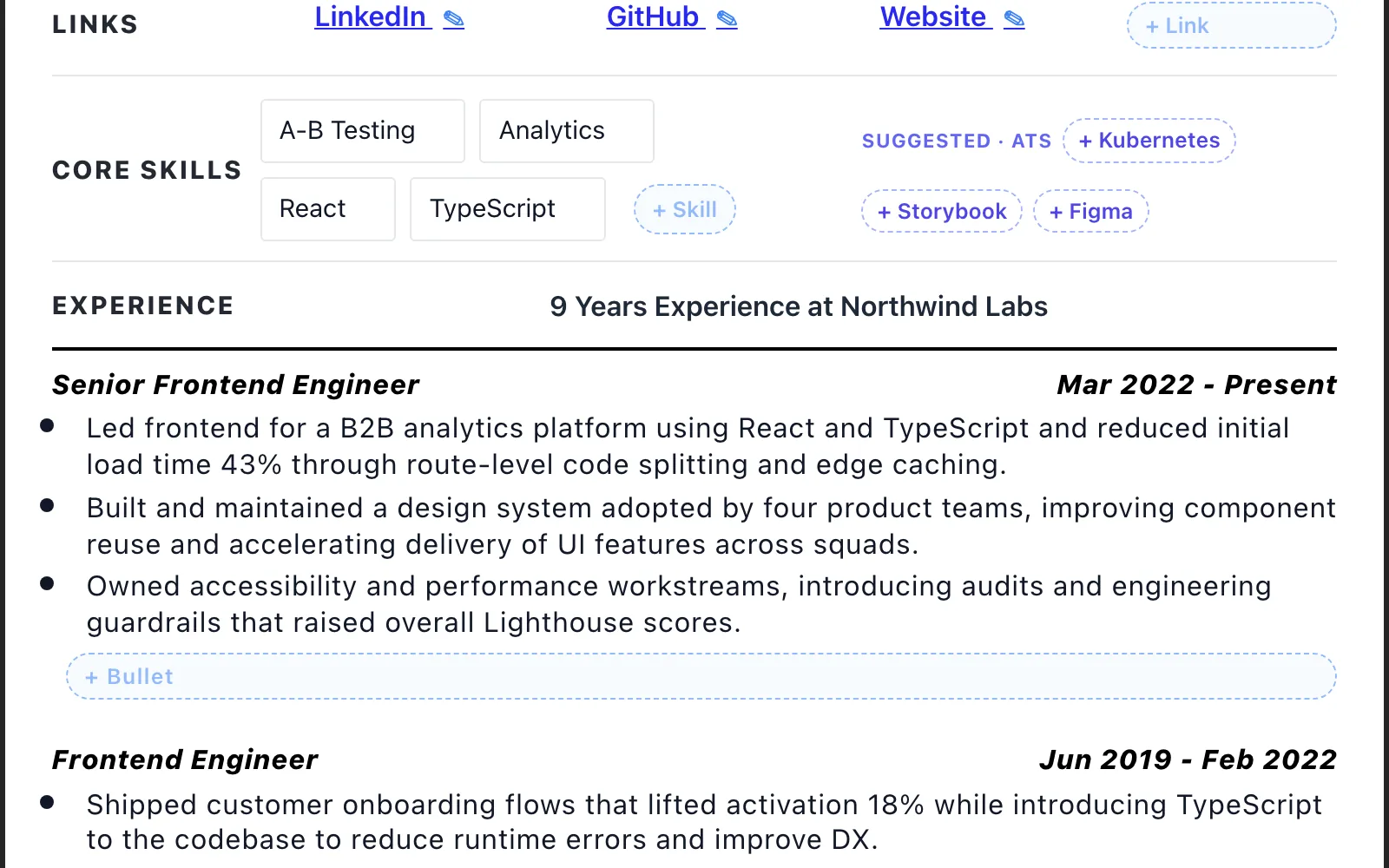
- Summary: the two or three headline must-haves, phrased as what you do rather than a list of nouns.
- Skills section: the exact tool, platform and method names, kept tidy and scannable.
- Recent job bullets: the keywords woven into real achievements, because this is where a reader checks whether the claim is genuine.
- Job title line: the ad's title where it accurately describes your role, so the top of the page instantly matches the top of the ad.
Older roles need less attention. Their job is to show continuity and depth, not to repeat the current ad's vocabulary.
Acronyms, exact matches and synonyms
Two people can search for the same job with different words, and so can two employers. The safe habit is to spell a term out once, then use the short form: "Search Engine Optimisation (SEO)" gives you both strings and reads naturally the first time. The same applies to job titles that have a long and a short version.
Where the ad uses a specific term and you use a synonym, prefer the ad's term if it is truthful. "Customer success" and "client retention" overlap, but only one of them is the phrase in the ad. If your real experience genuinely uses different vocabulary, keep your word and add the ad's term only where both describe the same work.
What not to do with CV keywords
Most keyword advice fails for the same few reasons. Avoid these:
- Stuffing. Repeating a term until it stops reading like a sentence. It helps no filter and costs you a reader.
- Hidden text. White text, tiny fonts or off-page tricks. It is a well-known tactic, it collapses the moment a human opens the file, and it destroys trust.
- Borrowed skills. Listing a tool you have never used. You will be asked about it.
- Copied sentences. Pasting lines from the ad into your bullets. It reads as templated and tells the employer nothing about you.
- Rewriting your history. Recasting ten years of work around one ad. Tailoring adjusts emphasis; it does not re-invent the past.
Before and after: one bullet, rewritten
Take an ad for a customer success manager that repeats a named CRM platform, "renewals", "onboarding" and "churn". A weak bullet describes the job in your own words:
Managed a portfolio of client accounts and handled their issues.
A keyword-aligned rewrite of the same true work says what the ad is looking for:
Managed a portfolio of 40 client accounts in [CRM platform], running onboarding for new customers and protecting renewals by acting on early churn signals.
Same job, same truth, very different match. Notice that the rewrite does not add a skill — it names the ones that were already there.
Doing this at scale, and what FuqHR automates
Tailoring does not mean rewriting your CV from scratch for every application. Keep one master CV, then create a version per application and group similar roles so the edits stay small. Realistically that is ten to fifteen minutes once you are practised; if it is taking an hour, you are rewriting rather than re-aiming. For the volume side of the search, pair the habit with a simple job search daily action plan so applications, follow-ups and tailored CVs stay visible in one place.
The other half of that record is the outcome: which version went to which employer, and what came back. A job application tracker in Google Sheets keeps that next to the plan, so after a few weeks you can see which kind of tailoring actually produced interviews instead of reconstructing it from memory.
The mechanical part can also be automated. FuqHR takes your existing CV and a pasted job ad and returns a tailored CV, a matching cover letter and an ATS score, so you can see how well the version matches before you send it. It rearranges and re-aims what you already have; it does not invent experience. If the process itself is new to you, our step-by-step guide to tailoring your CV to a job description covers the full workflow.
FAQ: CV keywords for a job application
How many keywords should a CV have?
There is no fixed number, and chasing one misses the point. Aim to cover the must-have terms that you can genuinely evidence, then add the most relevant nice-to-haves. A short list used precisely beats a long list sprinkled everywhere.
Can I use keywords I have not used on the job?
No. If you have never used the tool or done the task, leave it off. The gap is visible to a recruiter anyway, and a claim you cannot defend in an interview is worse than a missing keyword. If you are early in your career and the ad asks for experience you do not have, our guide to a CV with no experience shows what to put in place of a work history.
Do I need an exact match or can I use a synonym?
Prefer the ad's exact term where it truthfully describes your work, because that is the string the employer used and likely the one the software matches. Where your experience genuinely uses different vocabulary, keep your word and add the employer's only if both name the same thing.
Are keywords as important for small companies?
Smaller employers may read every application by hand, but they still skim. A CV that mirrors the ad's vocabulary is faster to read whether or not software is involved, so the habit pays off at any company size.
How do I check whether my CV actually matches?
Compare the finished CV against the ad one more time and tick off each must-have term. If several are missing and you can evidence them, the version is not finished. A scoring tool can shortcut the check by returning a match score for your CV against that specific ad.
The takeaway
Keywords are not a trick; they are the employer's own words for the job. Read the ad closely, mark what it repeats, keep only the terms you can honestly claim, and give each one a real home in your CV. Do that consistently and your applications stop looking generic — which is the whole reason they were being ignored.
See how well your CV matches the ad. Paste a job description and get a tailored, ATS-friendly CV with a live match score.