A student CV is not a shorter version of an experienced person’s CV. It is a different document with a different job: with few or no job titles to show, the evidence has to come from coursework, projects, part-time work and societies — and it has to be written so a recruiter can see the work, not the potential.
Below are three worked examples — an internship application, a first job after graduation, and a first-year CV with no paid work at all — followed by the education, project and skills sections that carry them, a copy-paste template, and the format rules that keep the file readable by an applicant tracking system.
What a student CV has to prove
Three things, and only three. That you can do the tasks named in the ad. That you have already done something with what you were taught. And that you will turn up and finish the work.
Everything else on the page is there to support one of those claims. A profile that says “hardworking, motivated, detail-oriented” supports none of them, because none of it can be checked. A bullet that says you rebuilt a messy dataset for a group assignment and presented the result supports the second one directly, and a reader can ask you about it in an interview. The opening paragraph is where that swap matters most, and our resume summary examples show it done in two lines, including the student and recent-graduate case.
That is the whole standard. When a line cannot be traced to a task, a piece of evidence or a reason to trust you, it is costing space on a page you only get one of.
Student CV example 1: internship application
Take a second-year economics student applying for a marketing internship at a consumer brand. No paid marketing work, one summer in a shop, a course project that involved real data. Here is what the top half of that CV looks like.
- Profile, two lines: “Second-year economics student applying for a marketing internship. Coursework in consumer behaviour and data analysis; built a customer segmentation for a local retailer and recommended a promotion based on it.”
- Education block: degree, institution and dates; the expected grade if it is strong enough to help; then two or three modules chosen because the ad mentions the same ground — consumer behaviour, market research, statistics.
- Project entry: “Segmented a retailer’s customer data for a coursework project, identified the group that bought least often, and proposed two promotions aimed at them; presented the findings and the method to a seminar group.”
- Experience entry: the summer retail job, written for what it proves — handling complaints, cashing up, training a new starter — rather than for the job title.
- Skills, one labelled line: the spreadsheet and analytics tools the ad names, plus any language you could hold a conversation in.
Two things make this work. The project bullet names a deliverable and a decision, not a subject. And the profile is a claim the rest of the page then proves — which is the only reason a recruiter keeps reading it.
If the ad asks for something you have only met in a classroom, say so in those words. “Used for a coursework project” is honest and still evidence; silence reads as nothing at all. The rest of the method — mirroring the ad’s language section by section — is the same one in how to tailor your CV to a job description.
Student CV example 2: first job after graduation
The same person, a year later, applying for a graduate role. The material has changed slightly and the order has changed completely.
- Experience moves above education, because there is now more to show than to study: the internship, the dissertation, the part-time job held through final year.
- The dissertation becomes a project entry at the same level as the internship, with the question it answered, the method and what came out of it. “Tested whether discount depth changed repeat purchase behaviour, using a transactional dataset and a regression model; the write-up argued that shallow, frequent discounts outperformed deep one-off ones.”
- The retail job gets a second bullet aimed at the new role: if the graduate job involves clients, the customer-facing part moves to the top of that entry; if it involves operations, the stock and till reconciliation does.
- The skills line loses the student scaffolding — no module names, no “currently learning” entries that a graduate should by now have finished.
The mistake at this stage is keeping the student structure and simply adding a line at the top. A graduate CV is read by someone asking “what have you done since you left?” — so the answer has to be the first thing on the page.
Student CV example 3: no work experience at all
A first-year with nothing paid on the page. This CV is thin only if it is written badly; the raw material is usually there.
- Coursework: “Wrote a business plan for a fictional startup as part of an introductory module, including a cost model and a competitor summary, and defended the pricing in a group presentation.”
- A group assignment: name your actual contribution. “Ran the research half of a four-person campaign brief for a local charity: interviewed volunteers, wrote the messaging and handed over a deck the charity then used.”
- A society role: treasurer, social secretary, fixture organiser — each one is scheduling, money or logistics with a real consequence if it goes wrong.
- Volunteering: a food bank shift, a reading programme, a club you coach. Write what you were responsible for, not how it made you feel.
- A self-taught project: a site you built, a spreadsheet model, a small business you ran for a summer. If it exists and you can explain the decisions in it, it belongs on the page.
Leave out school prizes nobody has heard of, hobbies with no bearing on the job, and any line that only asserts a personality. The page is short either way; make every line answer a question the reader is actually asking. If the “no experience” problem is the whole problem, the CV with no experience guide goes further on first-job applications specifically.
How to write the education section
Four elements, in this order: the degree, the institution, the dates, and then the detail that makes the degree relevant.
- The expected grade, if it is strong and the ad does not forbid it. If it is not, leave it out — an omission is not a lie, and the section still works.
- Relevant modules, in the ad’s language rather than the course catalogue’s. “Data analysis for business” means more to a recruiter than the internal code it is registered under.
- A dissertation or final project, one line, if it produced something you can describe.
- Nothing else — no list of every module, no secondary school once you have a degree, no unexplained gap in the dates.
Placement of the section depends on what you have. With no relevant work, education goes first because it is the strongest evidence you own. With an internship or a year in industry, education moves below experience and shrinks to three lines.
Turning coursework, projects and societies into experience
The shape is always the same: what the task was, what you did about it, and what came out. Students usually write the first part and stop, which is why their bullets read like a syllabus.
- Weak: “Did a group project on marketing.” — Better: “Built the messaging and the social plan for a four-person campaign brief, then presented it to a panel that included a local business owner.”
- Weak: “Volunteered at an animal shelter.” — Better: “Kept the shelter’s rehoming records and the volunteer rota in step, and rewrote the handover note so weekend staff stopped double-booking the van.”
- Weak: “Wrote a research paper.” — Better: “Surveyed commuters about ticket buying for a research methods module, cleaned the responses, and reported which payment method people abandoned most often.”
No numbers are needed for any of that. If you have a real, checkable figure — a dataset size, a budget you actually handled — use it. If you do not, describe the decision and the deliverable; that is the part an interviewer will ask about anyway.
Societies are the most under-used material on a student CV. Running a stall, booking a venue, chasing a supplier or keeping a club solvent are the same tasks that appear in junior operations, marketing and finance roles — they only look small because nobody wrote them down.
Part-time jobs and volunteering: what counts
All of it counts, as long as it is written for what it demonstrates rather than for the job title.
- Bar or café work: cash handling, stock rotation, working a queue, training a new starter, closing the till correctly at the end of a shift.
- Tutoring: explaining something difficult to someone who is not getting it, planning a sequence of sessions, keeping a parent or a student informed.
- Delivery or warehouse work: route planning, accuracy under time pressure, using a scanner or inventory system without losing stock.
- Charity shop: sorting and pricing donations, window displays, managing the till, supervising other volunteers.
- Club treasurer or secretary: a budget, a set of records, minutes and deadlines — the closest thing many students have to an admin job.
Do not inflate the title. “Customer service specialist” for a summer behind a counter invites a question you cannot answer well, and the honest version already contains everything the reader needs. Write the employer, the dates, the real title, and two bullets about what you were responsible for.
The skills section on a student CV
One short block, grouped by label, using the exact names the ad uses. Tools first, then languages with an honest level, then anything the job specifically requires — a licence, a certification, a method.
- Tools: the spreadsheet, analytics, design or coding tools you have actually used, named as the ad names them.
- Languages: “Spanish — conversational” is more useful than “Spanish — intermediate” and far more useful than a row of dots.
- Method: if the role asks for a method — survey design, bookkeeping, version control — name it here and prove it in a bullet above.
What does not belong: adjectives, star ratings, percentages, and any skill you could not survive a ten-minute conversation about. A short list that matches the ad beats a long list that matches nothing, and the terms worth copying come straight out of the posting — how to find keywords in a job description covers that pass. The mechanics of why a short list wins are in how ATS ranks your resume.
A copy-paste student CV template
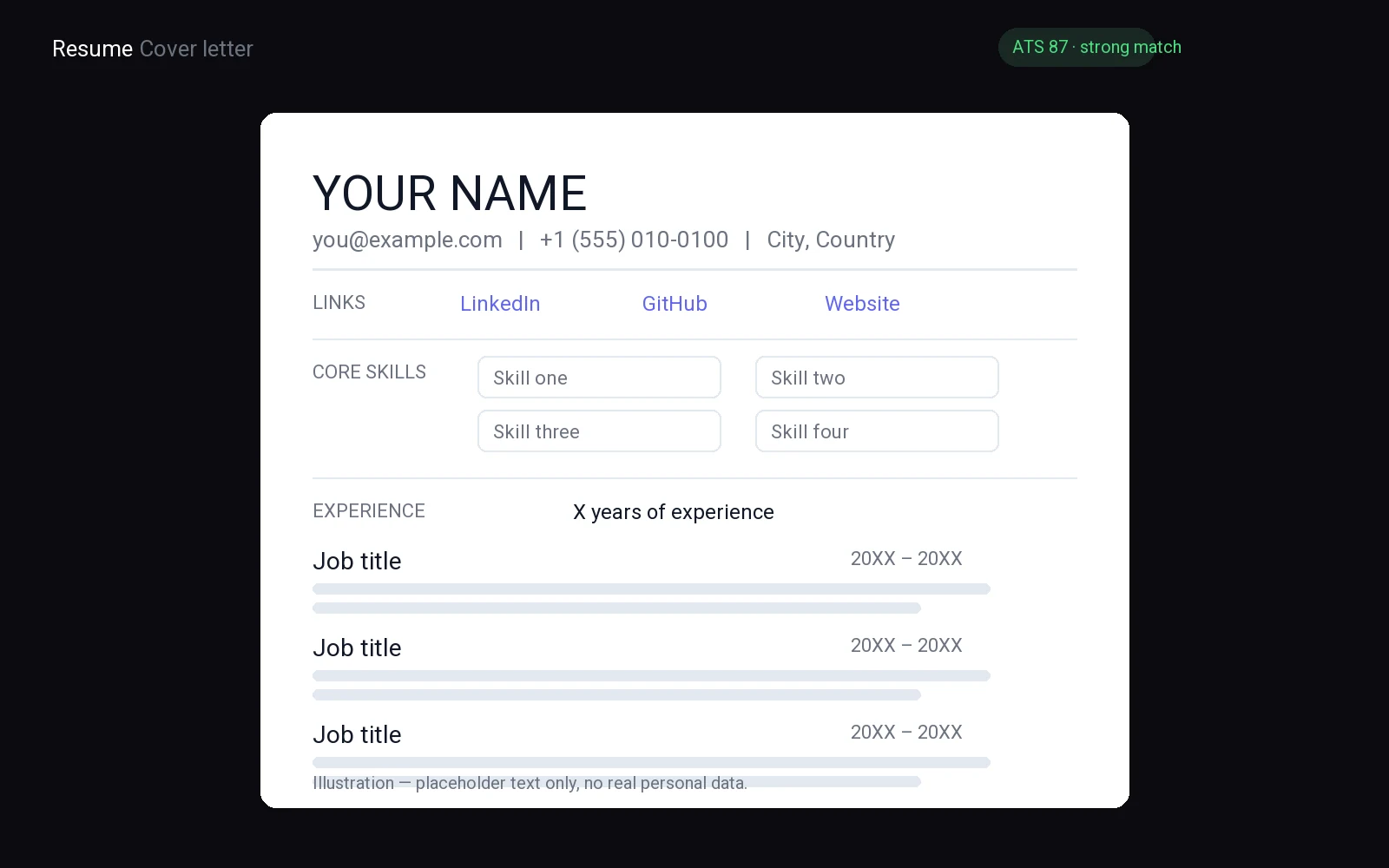
Paste this into a single-column document and replace each bracket. Delete any section you have nothing honest to put in — an empty heading is worse than a missing one.
[Full name]
[Email] | [Phone] | [City] | [Portfolio or LinkedIn, if you have one]

PROFILE
[One or two lines: what you are studying or have just finished, the role you are applying for,
and the single strongest piece of evidence that you can do it.]

EDUCATION
[Degree], [Institution] — [Start year] to [End year or "expected"]
[Expected grade, only if it helps]
Relevant modules: [Module in the ad's language], [Second module], [Third module]

EXPERIENCE AND PROJECTS
[Job title], [Employer] — [Dates]
- [Task] -> [What you did] -> [What came out of it]
- [Second bullet, aimed at this ad]

[Project or dissertation title] — [Course or context]
- [What the project was for, the method you used, and the deliverable you handed over]

SKILLS
Tools: [Tool], [Tool], [Tool]
Languages: [Language — level], [Language — level]
[Method or certification the ad asks for]

EXTRAS
[Society role] | [Volunteering] | [Anything the ad explicitly asks for]
The template is deliberately plain. Every label is a word an applicant tracking system recognises, the reading order is top to bottom in a single column, and there is nothing in it that depends on how it looks.
One page, ATS-safe: the format rules
- One page, written tightly, for anyone with less than a couple of years of experience. A second page with a third of it empty reads as padding.
- Single column. Tables, multi-column layouts and sidebars are the most common way a student CV loses its own content in parsing.
- Standard section names: Education, Experience, Projects, Skills. The software looks for those words.
- No text boxes, no photo, no icons used as labels. If the information only exists inside an image, it does not exist.
- No skill rating bars or percentages. They carry no text and no meaning to a parser, and they invite a test you may not want.
- A common font, exported as PDF — unless the ad asks for a Word file, in which case send the Word file.
- A sensible filename: your name, the role, and nothing else. Not “final”, not “v7”.
None of this is about taste. A clean single-column CV simply gives the software fewer chances to put your degree in the wrong field — and the same decisions make the page easier for a person to scan.
Mistakes that cost student applications
- A profile made of adjectives. “Motivated, passionate, hardworking” is three claims and no evidence.
- Every module ever taken. A long list buries the two modules the ad actually cares about.
- Hiding the part-time job because it “doesn’t count”. It is often the only proof of reliability on the page.
- Skill percentages and rating bars. Unverifiable, unparseable, and easy to be caught out on.
- Two pages with one page of content. The reader notices the padding before the achievements.
- Sending the same file to every posting. The skills line and the profile are the two places a student CV has to change, and they take minutes.
The fix for most of these is the same: read the ad, then read your CV as if you were the person hiring. Anything that does not help them decide is taking up room. Doing that for every posting is a routine rather than a one-off, and our free job search action plan template lays out a daily version of it.
Want the match checked before you send it? Paste the posting into FuqHR and it rewrites your CV against that specific description, returns a cover letter in the same pass and shows an ATS score before and after. Start free — free while FuqHR is in beta, no card.
Student CV Personal Statement Examples
A personal statement on your student CV can differentiate you from other candidates with limited professional experience. Tailor it to each role, framing your academic background, skills, and interests around the job you're targeting.
- Start by naming the role and highlighting your key strength relevant to it, grabbing the recruiter's attention.
- Highlight academic or extracurricular experiences that demonstrate skills applicable to the job, such as projects, volunteering, or leadership roles.
- Conclude with a clear statement about your potential contribution to the team, showing you've researched the role.
For instance, a computer science student applying for a software development internship might write: “Computer science undergraduate with hands-on full-stack web app development experience through university projects and campus coding club. Eager to apply my JavaScript skills and problem-solving abilities to support your team’s product development, while learning from senior engineers to enhance my technical skills.”
References on a Student CV
Deciding whether to include referees on a student CV depends entirely on space availability and employer instructions. For an internship or entry-level position, hiring managers rarely expect formal reference letters upfront because your academic and extracurricular credentials carry the primary weight. Instead, prioritize showcasing relevant project work, part-time jobs, and transferable skills.
You should completely omit the outdated phrase references available on request. Recruiters already assume you can provide references, and including this filler statement wastes valuable page space that is better dedicated to your achievements.
Only list referees directly on your CV if the job application explicitly requests them. When required, follow these formatting guidelines:
- Include two professional or academic contacts, such as a university professor who supervised your capstone project or a manager from a previous internship or part-time job.
- Provide their full name, professional title, organization, email address, and phone number.
- Always obtain permission from your referees before sharing their contact details with prospective employers.
Keep your reference section clean, concise, and aligned with the formatting of the rest of your document.
FAQ
How long should a student CV be?
One page. With little experience there is rarely enough real material for a second, and a tight page reads as confidence. If you genuinely cannot fit it, cut the least relevant module list before you add a page.
What if I have no work experience?
Use coursework, projects, volunteering, society roles and anything you taught yourself. Write each one as a task, an action and a result, and say plainly where it came from — a coursework project presented honestly is stronger than a vague claim about being a fast learner.
Should I put my grades on a student CV?
Include them when they are strong and the posting does not ask you to leave them out. If they are not, omit them rather than explaining them on the CV; the interview is the place for context, and the rest of the page still has to stand on its own.
Do I need a different CV for every internship?
You need the same CV re-aimed, not rebuilt. Rewrite the profile, re-order the skills line to match the ad, and swap which module or project you lead with. That is a few minutes of work per application and it is the difference the reader notices.
Can I use the same CV for an internship and a graduate job?
No, because the two documents answer different questions. An internship CV leads with education and projects; a graduate CV leads with what you have done since, and treats the degree as supporting evidence. Keeping an old version and adding to it is how a graduate CV ends up looking like a student one.
The bottom line
A student CV is an evidence document, not a statement of potential. Pick the three things the ad actually needs, then prove each one with something you did — a project, a shift, a society role, a dissertation. Keep it to one page, in one column, with standard headings so the software reads it the way you wrote it. Then aim it at the posting in front of you, because the version that was good enough for the last application is the reason this one gets no reply.