Almost every AI resume tool promises the same thing: a resume that gets past the robots. But they are solving different problems. Some scan and score the resume you already have. Some build a new one from scratch. Only some actually rewrite your existing resume for one specific job posting.
This is a straight comparison of the four tools job seekers ask about most: FuqHR, Jobscan, Rezi and Resume Worded. We look at what each one is built for, what it costs in 2026, and where each one is the wrong choice — including where FuqHR is the wrong choice.
One note before we start: free tiers and prices change often. Everything below was checked on each vendor's own pricing page in October 2026, and you should confirm it there before you buy.
Jobscan alternatives: the short answer
Jobscan is the scanner most people try first, so this page treats it as the baseline: three alternatives worth your time, what each one is best at, and the one case where Jobscan itself is still the right buy.
- FuqHR — if you already have a resume and want it rewritten for one specific job posting, with a matching cover letter, free while FuqHR is in beta.
- Jobscan — if you want an established match-rate scanner, a job tracker and LinkedIn optimization in one paid subscription.
- Rezi — if you would rather build the resume inside a dedicated editor, and you like the one-time lifetime option.
- Resume Worded — if what you want most is detailed, line-by-line feedback on your bullets and a review of your LinkedIn profile.
- None of the above — if your applications are failing at the interview stage rather than the screening stage. No scoring tool fixes positioning, and no AI fixes a resume that is not true.
What each tool is actually for
FuqHR
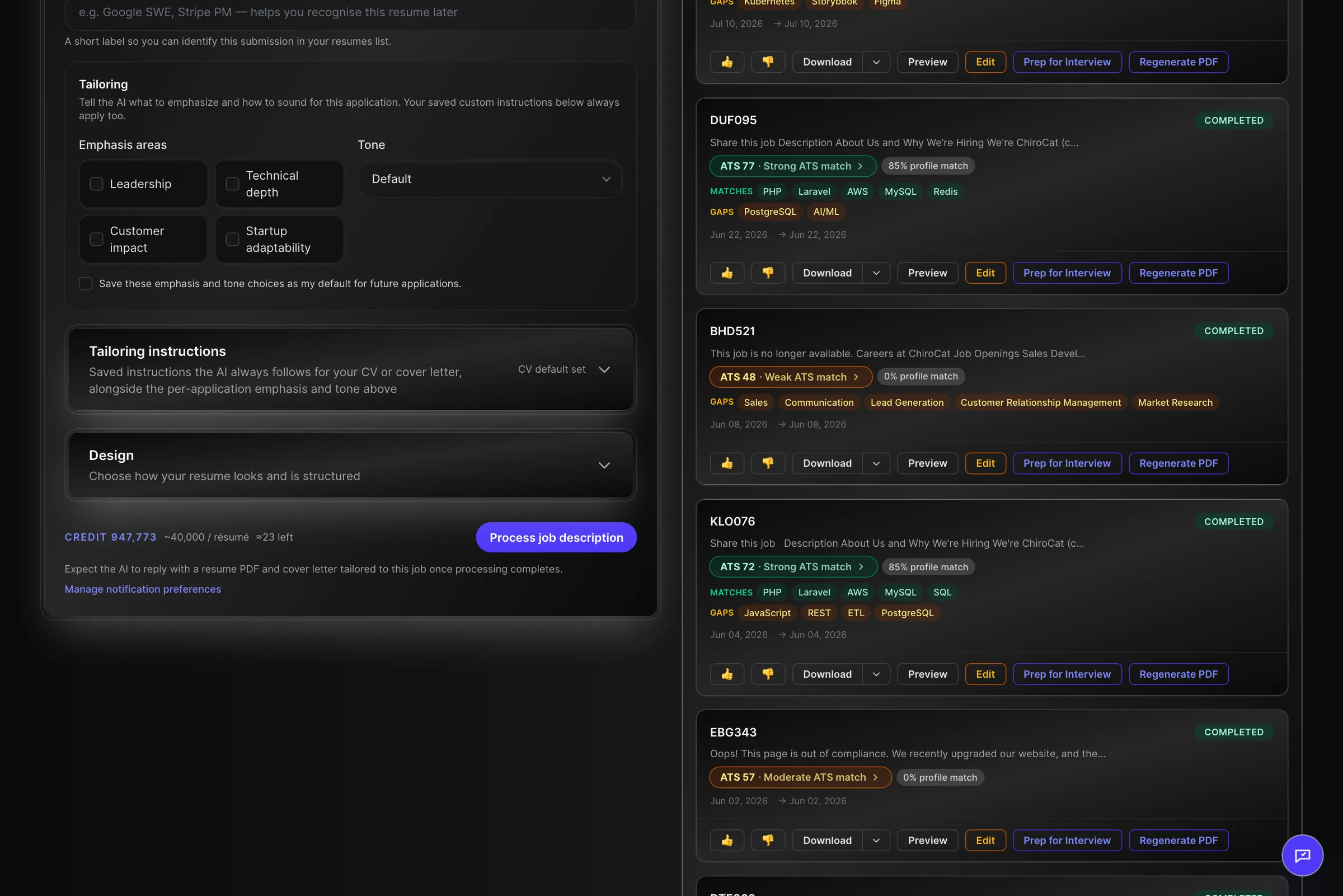
FuqHR is paste-and-rewrite. You bring the resume you already have plus the job ad you are applying to; it rewrites the resume against that posting, generates a matching cover letter, and scores the result 0–100 on six weighted criteria you can see separately. It also drafts interview questions from the same posting and estimates a salary range, or says it is unknown when the ad gives nothing to work with. It is free while in beta, with 1,000,000 credits on signup and no card required.
- Best at — turning the resume you already have into a version aimed at one posting, quickly, with a visible breakdown of what is dragging the score down.
- Where it is weak — it is new. There is no in-app application tracker, no LinkedIn optimization and no mobile app.
Jobscan
Jobscan is an analyser. You upload a resume and a job description and it returns a match rate plus the keywords you are missing. It has been the default name in this category for years, and the paid tier adds Power Edit, LinkedIn optimization, a job tracker and a couple of Auto Apply credits a month.
- Best at — a well-known match-rate score, application tracking in one place, and LinkedIn work.
- Where it is weak — it is a scanner, not a writer. It tells you what is missing; the rewriting is still your job.
Rezi
Rezi is a builder. Instead of importing a document and fixing it, you construct the resume inside Rezi's editor, with AI writing and editing tools, a Rezi Score and keyword targeting on paid plans. It also offers a Chrome extension and interview practice.
- Best at — building a clean, ATS-friendly resume from a blank page, with a one-time lifetime plan if you would rather not subscribe.
- Where it is weak — it is built around its own editor, which is more friction if you already have a finished master resume you simply want to adapt.
Resume Worded
Resume Worded is a feedback tool. You upload your resume and it returns a score with line-by-line comments; you can paste a job description to see keyword gaps, and the LinkedIn review is a separate product from resume scoring. Pro unlocks unlimited complete reviews, AI rewrites and templates.
- Best at — teaching you what is wrong with your writing, bullet by bullet.
- Where it is weak — it coaches rather than rewrites, there is no dedicated Pro trial, and first purchases are generally non-refundable.
Pricing compared
Verified in October 2026 from each vendor's own pricing page. Vendors change this often, so treat it as a starting point, not a contract.
| Tool | Free tier | Paid entry price | What paying unlocks |
|---|---|---|---|
| FuqHR | Free while in beta — 1,000,000 credits, no card | None yet — no paid plan exists | Nothing to unlock: tailoring, cover letters, scoring and the export kit are all in the beta |
| Jobscan | 5 resume scans per month | $49.95/month, or $89.95 per quarter (about $29.98/month) | Unlimited scans, Power Edit, LinkedIn optimization, job tracker, 2 Auto Apply credits/month |
| Rezi | 1 resume, 1 AI interview, 3 PDF downloads | $29/month, or a one-time $149 lifetime plan | Unlimited resumes, unlimited AI writing and downloads, all templates, Rezi Score, keyword targeting |
| Resume Worded | A real resume score plus a limited report preview | $49/month, $99 per quarter (about $33/month), or $229/year (about $19/month) | Unlimited complete resume and LinkedIn reviews, targeted keyword gaps, AI rewrites, templates |
Over a three-month search the total cost matters more than the headline price. Jobscan and Resume Worded cost roughly $49 a month if you pay monthly, which is about $150 across twelve weeks; their quarterly plans bring that to about $90–$99. Rezi's monthly plan is cheaper at $29, and its one-time $149 lifetime option is the obvious pick if you expect to job-search again in a few years. FuqHR costs nothing at all while it is in beta — which is a fair reason to try it first and decide about the others later.
There is one more distinction worth pricing in: two of these tools tell you what to fix, and two do the writing. You are paying for advice or for labour — decide which one your job search is short of. See FuqHR's pricing page for what "free in beta" actually includes.
Tailoring vs scoring: the difference that matters most
This is the distinction people miss. A scoring tool measures the gap between your resume and the ad. A rewriting tool closes it. Both are useful, but they are not the same product. If you would rather find the keywords yourself first, our guide to extracting CV keywords from a job description covers the manual route.
- FuqHR rewrites. You paste a posting and your current resume, and you get back a resume rewritten for that posting. You review and edit it; you do not start from a blank document.
- Jobscan scores. It returns the match rate and the missing keywords, and you make the edits yourself.
- Resume Worded critiques. It tells you which lines are weak and why; you rewrite them.
- Rezi builds. Keyword targeting and AI help live inside its editor, so your starting point is a new document rather than an existing one.
Neither approach is inherently better. If you want to become a better resume writer, feedback is the higher-value loop, because the skill stays with you. If you are applying to twenty postings this month and each one needs to be tailored, automation saves hours every week. Most serious job seekers eventually want both.
Why ATS scores are not comparable between tools
An ATS score only means something inside the tool that produced it. Every vendor uses its own criteria and its own weights, so an 80% in one tool and an 80% in another are two different measurements that happen to share a number. Comparing them across tools — or treating a competitor's score as a benchmark for yours — is a mistake.
FuqHR's 0–100 score, as one concrete example, is built from six weighted criteria, all published on our how FuqHR scores a resume page:
- Hard skills — 30%: the tools, technologies and qualifications named in the posting, matched against what your resume actually evidences.
- Experience — 20%: the depth and relevance of your history against what the role asks for.
- Job title — 15%: how closely your most recent title reads against the target role.
- Education — 15%: the qualifications the posting asks for, where it asks for any.
- Soft skills — 10%: whether the posting's soft skills are demonstrated through achievements rather than listed as keywords.
- Parseability — 10%: whether the document structure itself is machine-readable.
Hard requirements stated outright — a required degree, a minimum number of years, work authorisation — are reported separately as pass/fail, because they are not a matter of degree. Other tools use entirely different breakdowns, which is exactly why the same resume can "score" wildly differently from one product to the next.
If you want to understand what the software is doing when it reads and ranks you, see how ATS ranks your resume.
Which tool should you pick?
- You have a resume you are happy with and you are applying to many similar roles. Use a tool that rewrites, so each posting gets its own version without the manual work. FuqHR, free while in beta, is the cheapest way to test that workflow.
- You are not sure why your resume is not landing. Use Resume Worded. You want the diagnosis, not another document.
- You are starting from nothing, or from a document you no longer trust. Use Rezi and build it properly inside the editor. If the blank page is the problem because you have no work history yet, our guide to a CV with no experience starts from there.
- You want scanning, tracking and LinkedIn in one place, and you are ready to pay. Use Jobscan.
- You need a tracker today and do not want another subscription. Use our free Google Sheets job application tracker instead.
One more honest note for your schedule: none of this matters if you apply to five jobs a week. Volume and follow-up still decide most searches. Our daily action plan covers that side of the work. For the tailoring step itself, see our step-by-step guide to tailoring your CV to a job description.
What we do not claim
FuqHR is the tool this site belongs to, so weigh this page with that in mind. We have tried to be specific, to price everyone accurately, and to point you at competitors where they are the better fit.
Two limitations, said plainly. FuqHR is in beta: there is no in-app application tracker, no LinkedIn optimization and no mobile app yet, and Jobscan, Rezi and Resume Worded are more mature products with features FuqHR does not have. And no AI tool can tell whether a score will get you an interview — the score decides who gets read, a person still decides who gets hired.
FAQ
What is the best free Jobscan alternative?
FuqHR is the free option while it is in beta: the whole tailoring workflow, not a trial. Rezi and Jobscan both have free tiers, but they limit how much you can do inside them. If you want one tailored resume per posting without a subscription, start with FuqHR; if you want to diagnose a resume you already like, use Resume Worded.
Which of these is the best AI resume tailoring tool?
Pick by workflow. If you want to see what is missing before you apply, choose a scanner (Jobscan) or a feedback tool (Resume Worded). If you want the resume already rewritten for the posting, choose a rewriting tool such as FuqHR, which is free while in beta.
Are ATS scores from different tools comparable?
No. Each vendor uses its own criteria and weights, so the number is only meaningful inside the tool that produced it. Use a score to find gaps in one specific application, never as an absolute measure of your resume.
Is FuqHR really free?
Yes, for now. FuqHR is in beta: accounts start with 1,000,000 credits, there is no card field in signup and no paid plan exists yet. When paid plans launch, beta accounts get notice first and keep what they have already built.
Do I have to pay to tailor one resume to one job ad?
No. All four tools let you test the core idea for free: Jobscan gives 5 scans a month, Rezi 1 resume and 3 PDF downloads, Resume Worded a real score with a limited report, and FuqHR the whole tailoring workflow while it is in beta.
Can recruiters tell that a resume was AI-tailored?
There is no reliable "AI detector" for resumes, and most recruiters are not screening for one. The real risk is not detection, it is accuracy: tailoring rewrites only work if everything on the page is true about you. Read every line and cut anything the AI invented.
The bottom line
Choose by workflow, not by brand. If you need speed across many applications, use a tool that rewrites — FuqHR while it is free. If you want to get better at writing resumes, use a feedback tool like Resume Worded. If you are starting from zero, build inside Rezi. If you want tracking and LinkedIn in one place and will pay for it, Jobscan. Whichever you pick, the winning move is the same: tailor to the posting, tell the truth, and apply consistently.
Try the rewrite workflow free. Paste your CV and a job ad, get a tailored, ATS-scored application in minutes — no card, no trial timer.